

“In this world there are only two tragedies. One is not getting what one wants, and the other is getting it.”
- Oscar Wilde
“The heart has its reasons, which reason does not know.”
- Pascal
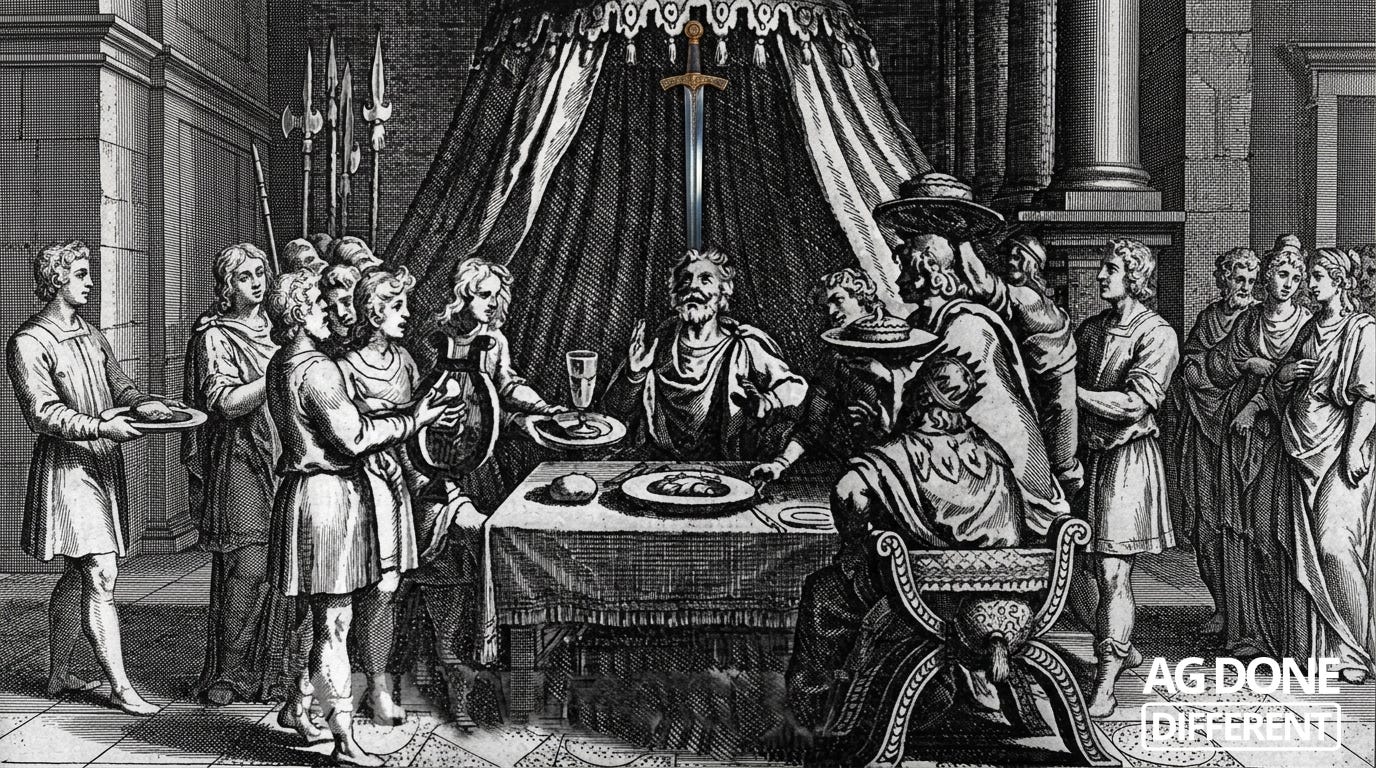
More than 2,000 years ago, Cicero recounted the fable of the Sword of Damocles.
Damocles was a courtier of Dionysius, the tyrant of Syracuse. Admiring the ruler’s wealth and majesty, he declared that Dionysius must be the happiest man in the world.
Dionysius offered to let him find out. He arranged for Damocles to enjoy a magnificent banquet, surrounded by the comforts and luxuries of being king.
He added just one thing.
Above Damocles’ head, he hung a sword by a single horsehair.
Suddenly, Damocles could no longer enjoy the food or admire the riches around him. All he could think about was the blade hanging over his head. Eventually, he begged to leave.
It turns out that being the king wasn’t all that he thought it was cracked up to be.
In 1969 Harvard marketing professor Theodore Levitt wrote a book called “Marketing Mode,”
In which he famously quoted a New York ad executive named Leo McGivena saying,
“People don’t want to buy a quarter-inch drill bit. They want a quarter-inch hole.”
The point is that the drill bit is a means to an end. What customers really want is the hole it makes.
But Cicero’s story about Damocles shows us that Levitt and McGivena didn’t go far enough. Your customers don’t want a hole any more than Damocles wanted a banquet.
The banquet and the drill bit are merely features.
What they really want is to walk into the room and see the people they love.
Perhaps they want someone else to notice; to admire what they’ve built; to see them as capable.
As marketers, we have to realize that no one wants a quarter-inch drill bit or a quarter-inch hole; they want to feel healthy, wealthy, and connected.
In agriculture, we are really good at selling what author Donald Miller calls “external solutions.”
“Here’s our combine.”
“Look at the new features of our robot.”
“Check out this financing package,”
“Look at the yield from our latest hybrid.”
But as Miller correctly points out, customers buy to solve internal problems, not external ones.
We are really good at explaining what our product does.
The customer is considering what choosing it will mean for their life. Underneath the product discussion, questions like these are being asked:
1. “How will this help me avoid (some fear I have)?”
This is the story customers tell themselves, which may be very different from the explanation they give everyone else. They might say they want better efficiency. Privately, they’re wondering whether they can keep doing this for another ten years, or whether one bad decision could undo everything they’ve worked for.
2. “How will this affect my standing with people whose opinions matter to me?
Status is relative. We judge our progress against the people around us - who’s up and who’s down. We want to be respected for our judgment, recognized for our work, and seen as someone who knows what they’re doing. A purchase can offer that recognition. It can also put it at risk.
3. How will this help me to connect with people I care about?
This is what people are talking about when they say the word “community.” It’s fitting in, knowing the right words to the right songs.
As Seth Godin has said, all marketing can be boiled down to the phrase “people like us do things like this.”
Marketing turns on these questions of fear, status, and connection.
When we craft our offer to our customers, we need to understand what drives their choices. And that means looking beyond the proxies and substitutes they say they want to what they actually want.
Make something different. Make people care. Make fans, not followers.