
Ellison's Law
Why sounding like everyone else is the fastest way to become a commodity.

“If everyone is thinking alike, then somebody isn't thinking.”
- General George S. Patton
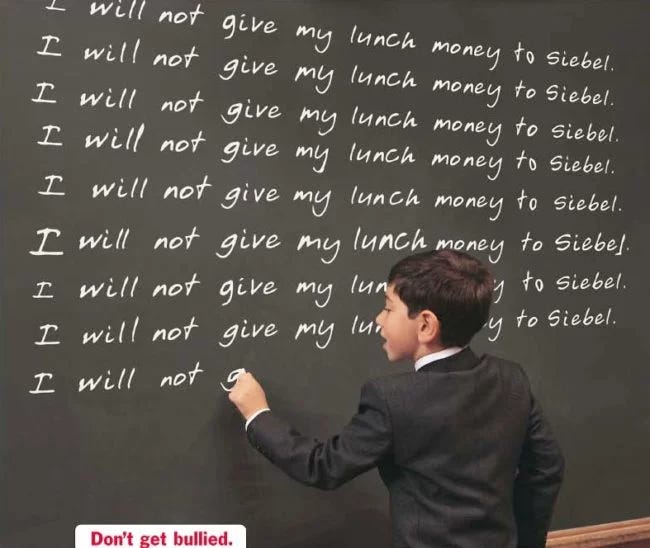
Rick Bennett is the creative genius behind my favorite Salesforce ad of all time…
”Stop Giving Your Lunch Money to Siebel.”
It ran in 2002. It’s still a great ad.
But even better was a lesson that Rick learned while working with Larry Ellison in the early days of Oracle. He still calls it “Ellison’s Law.”
“Ellison’s law states that you are not allowed to say anything that one of your competitors would say—whether in website, email, anywhere.”
Not on your website, not in your emails, not in your presentations.
Nowhere.
It’s simple, even a little brutal, and if you’ve spent any time in agricultural marketing you know it is nearly impossible.
Because most companies eventually convince themselves that the safest strategy is to sound just like everyone else, and the gravitational pull of that belief across organizations, big and small is extremely hard to battle against.
We’ve all been in this meeting.
The head of sales says, “guys, if we just drop our price, we will be able to sell way more of this product because we will finally be the cheapest.“
The CFO says “no way. You can’t do that. That’s a race to the bottom, you’ll destroy the margins we need in order to survive.”
And we all know that the problem with a race to the bottom is you might win. Or worse, you might come in second.
As Dan Kenneday famously quipped, “There is no strategic benefit to being the second cheapest in the marketplace.”
Finally someone, maybe the CEO trying to be a peacemaker or some consultant says, “All right, let’s raise the price. Because if we raise the price a few bucks, our margins will go up.”
But the head of marketing (hopefully) says, “no, you can’t do that. Our customers are not stupid. They are not going to pay extra for the same thing.”
And around and around it goes.
Eventually companies usually run over the CFO and drop the price, but it doesn’t work because price is almost never the real problem.
The only way to escape comparison is to become the only option, which naturally raises the question:
How do we become the only option?
First, stop being average.
In 2011, researchers at National Geographic generated a composite image of the world’s most statistically “typical” person by blending thousands of faces together.
Here’s what came out:

What they found was that average isn’t beautiful, it isn’t really even well-defined or especially interesting to look at. It’s just average.
In agriculture, we all claim to be “innovative,” we all claim to be “for the farmer,” we all claim to be “improving efficiencies,” we all claim to be “helping improve decisions,” we all claim to be your “trusted advisor.” And on and on…
The problem is that our customers have taken our word for it; They’ve heard us say again and again, “we’re all the same.” And now they believe us. We’ve told them that we’re all the same, and finally, they believe us.
People don’t spread average ideas.
They spread ideas remarkable enough to merit remark, something that gives them status.
People talk about products, companies, and movements that are different enough to interrupt the humdrum conversation of daily life.
If your customers won’t tell your story for you, your marketing eventually runs out of oxygen.
Ellison’s Law is all about categorical distinction. The ability to say “we’re this, not that.” The ability to say “we made this for you” instead of “you can choose anyone, because you know we're all really the same."
The moment your competitor can make the same claim, you’ve volunteered to be compared, and once you’re being compared, the conversation almost always devolves to price.
Because you’ve surrendered the last meaningful point of distinction.
So maybe the question we should be asking is:
“What can we become that our competitors can’t honestly say they are?”
Ellison’s Law isn’t really about copywriting, or even about conventional “marketing” at all; it’s about courage.
The courage to build a company with a point of view so distinct that your competitors can’t borrow your language without changing who they are.
That’s the goal. To become something so unmistakably different that comparison stops making sense.
The companies that will own the future of agriculture will be those whose marketers sound different because they are properly representing the organization they serve, not because they are more creative copywriters.
Make something different. Make people care. Make fans, not followers.