
The Language Trap
Why AgTech Companies Build the Future While Describing the Past

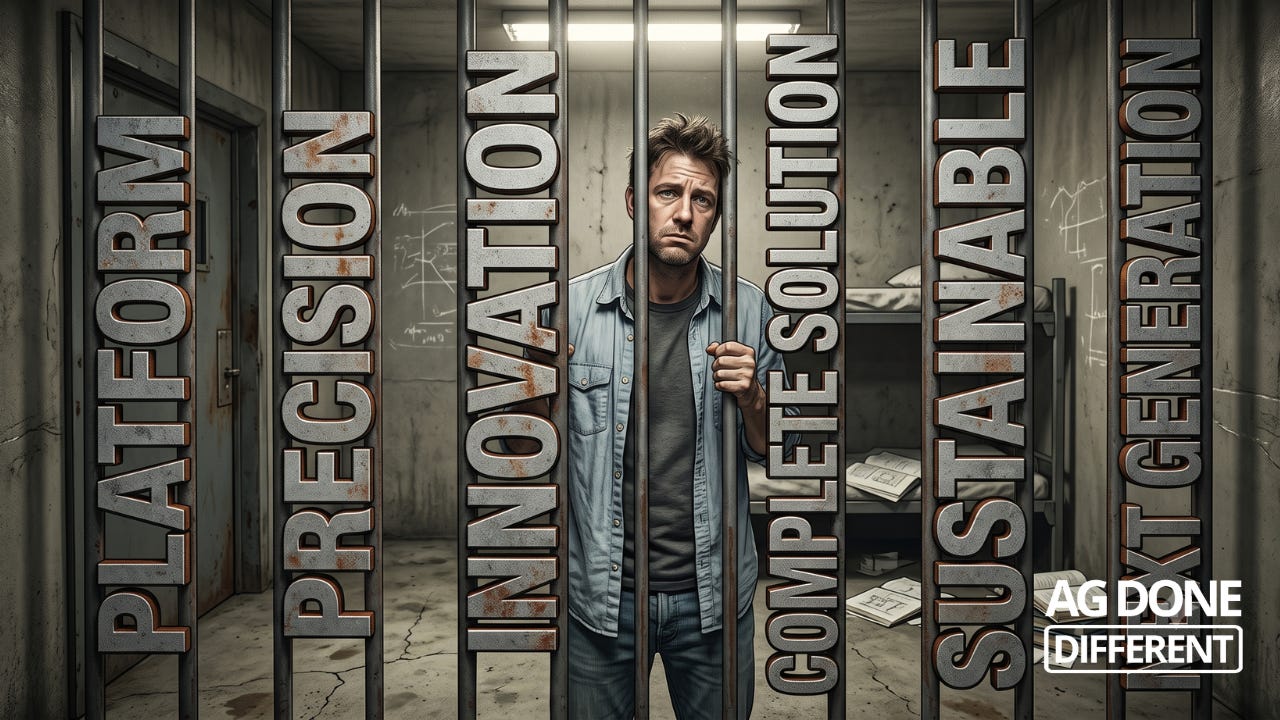
"The limits of my language mean the limits of my world."
- Wittgenstein
"The beginning of wisdom is to call things by their proper name."
- Confucius
There’s a dangerous messaging myth in agtech.
It’s quietly costing companies millions—and no one’s talking about it.
The myth goes like this:
“We just need to get the word out.”
It sounds harmless. Ambitious, even. But underneath it lies a deadly assumption:
That the message already matters.
That people are already listening.
That the problem you solve is already understood.
In agtech, none of these things are true.
The result? Teams scramble. They hire agencies. They chase clicks, impressions, and followers. They tweak taglines. They spend tens of thousands on brand guides and creative briefs. They run Lightning Strikes that light up nobody’s radar. They sponsor trade show booths that get compliments, but not conversions.
And they wonder why nothing sticks.
The hard truth is that the market doesn’t get what you’re doing because you haven’t made it matter.
Until you do, every dollar spent on messaging is just noise…polished, pretty noise.
This isn’t just a marketing failure. It’s a category failure.
And you can’t solve a category failure with copywriting tricks. You need to change the narrative.
A Tale of Two Cities: Better-town vs. Different-ville

Let’s explore this idea with a story.
It’s a story of two towns. Facing the same crisis. With very different outcomes.
Bettertown was proud, proper, and disciplined. When a recession hit, and unemployment soared, the town council felt trapped between two bad options: do nothing or give handouts. Neither felt right, so they invented something they thought was “better.”
They created a relief program—but not just any relief program.
This one was designed to discourage dependence. If you wanted help, you had to prove your desperation. Applications were long. Interviews invasive. Relief officers could show up unannounced to inspect your fridge, budget, and home. The message was clear: help comes with shame.
They thought this would preserve character. Instead, it created resentment.
The unemployed were humiliated, and the employed were smug. Tensions rose, and trust fell. While the worst was narrowly avoided, the town lost something deeper—its sense of unity.
Different-ville took another approach.
They didn’t start with the problem. They started with a principle:
“Unemployment is like a house fire—an unpredictable disaster no one asks for.”
They reframed the situation entirely.
They called it insurance, not welfare. Every resident who’d contributed to the community—by working, paying taxes, or building—had earned the right to claim a payout during hardship. These weren’t handouts. They were claims on value already created.
And they celebrated it.
The first checks were handed out at a town-wide event. Flags. Speeches. Photos with the mayor. It was civic pride, not pity.
When a skeptical reporter asked the mayor, “Isn’t this just clever PR? Haven’t you just renamed welfare by calling it insurance”
The mayor replied:
“What do you mean, calling it insurance? It is insurance.”
Most of our companies are stuck in Better-town.
We build something useful, maybe even powerful. But instead of framing a new future, they describe features, specs, outputs, and capabilities. They assume people will connect the dots.
They don’t.
Because the industry is saturated with noise. And when your messaging echoes the status quo—even unintentionally—you reinforce the very mindset you're trying to change.
If Better-town teaches us anything, it’s this:
Your narrative doesn’t just influence perception. It defines reality.
You’re not selling “better.”
You’re not selling “innovation.”
You’re selling a new mental model, a new way to see what matters.
And that starts with language.
No one understood this better than Howard Schultz.
Schultz wasn’t always a billionaire coffee mogul. He was a kid from the Brooklyn projects.
When he was seven, he watched his father—an unskilled laborer—get injured and immediately fired without benefits or support. His dad collapsed on the couch, broken and bitter, unable to find work that gave him meaning.
That image haunted Schultz.
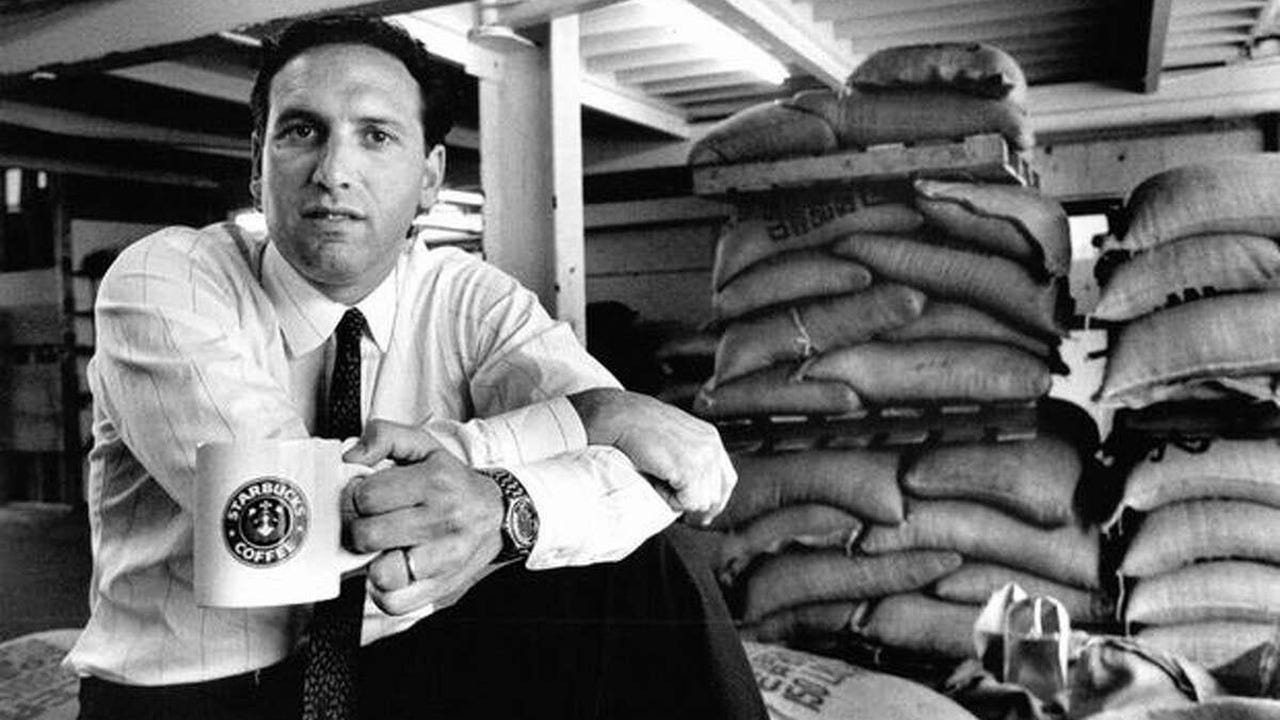
He didn’t just want a job. He wanted to do work that meant something.
Years later, as marketing director for a tiny coffee and tea company called Starbucks, Schultz visited Italy. What he found wasn’t just espresso—it was experience.
“The energy pulses all around you,” he said. “These places offered comfort, community, a sense of extended family.”
He watched baristas dance behind the counter, pressing espresso, steaming milk, and laughing with customers. It wasn’t a transaction. It was theater. It was ritual. It was human.
He didn’t come home wanting to import better beans. He came home determined to import a story.
At the time, Starbucks sold great coffee beans, but only to a niche elite. Schultz realized they weren’t scaling because they were trying to market a premium product without a premium story.
So he gave Starbucks one. He developed unique language around the brand.
They began to serve coffee by the cup.
They created an inviting, sensory-rich “Third Place.”
They renamed the roles: servers became baristas; they were partners in the business.
Drink sizes weren’t small/medium/large—they were Tall, Grande, Venti.
They didn’t sell coffee with milk. They sold Caffè Lattes.
And just like that, the product stopped being a commodity. It became an experience.
A shift in language creates a change in thinking, which creates an adjustment in action, and leads to a transformation in outcome.
Read that again.
Starbucks didn’t win just because people thought the coffee was better.
They won because people thought they were better when holding a Starbucks cup.
Dunkin’ didn’t get that. In 2008, they ran a double-blind taste test and proudly announced that people preferred Dunkin’ coffee to Starbucks. They launched DunkinBeatsStarbucks.com and bragged about their win.
And yet, Starbucks today dwarfs Dunkin’.
Because coffee wasn’t the point.
The rise of Starbucks wasn't built on the whims of people tasting two unnamed coffees side by side and picking a winner. It was built on the context within which that coffee was enjoyed.
The same insight showed up at a university hospital in Michigan.
A team of researchers interviewed the cleaning staff.
Same job. Same pay. But half said their work was low-skilled and boring. The other half said it was deeply skilled and meaningful.

What was the difference between the two groups?
The language they used to describe their role.
One group said, “It’s just cleaning. Like what you do at home.”
The other referred to themselves as ambassadors—people who formed relationships with nurses, patients, and visitors to create an environment for healing.
Their job hadn’t changed. Their words had.
And because their words changed, their behavior toward their job did, too.
AgTech is full of legendary innovators.
Engineers who’ve built machines that aim, adapt, and learn.
Platforms and sensors that visualize every inch of every acre in real time.
Tools that could fundamentally transform the economics of growing food, fuel, and fiber.
But what happens next?
They take this game-changing technology—and describe it as “a complete agronomy platform.”
They build systems that could redefine decision-making—and call it “next-gen precision.”
They release tools that remove friction, add intelligence, and give growers control, but they market them using the same bloated language as everyone else.
They look at incumbent solutions and the way customers talk about things today and assume they’re permanent. They assume they’re neutral. But they’re not.
It’s designed.
The language customers use was built by your competition.
And the minute you adopt it, you’re reinforcing their worldview. You’re anchoring your new story to someone else’s legacy. And you’re inviting customers to make side-by-side comparisons on their terms, not yours.
This is the subtle failure behind most agtech messaging:
You build something new.
You describe it like something old.
And then you wonder why it feels like no one “gets it.”
The language doesn’t match the leap.
And because the language doesn’t match the leap, the market can’t feel the difference.
When that happens, all your innovation gets flattened. You become Better-town.
You end up reinforcing the category king instead of dethroning them.
Here are two real-time examples:
Verdant Robotics
Their current messaging?
“Precision you can see. Results you can trust.”
“The future isn’t spraying. It’s aiming.”
Now let’s translate that for a skeptical grower:
“You do spraying? So does Deere.”
“You aim? So does See & Spray.”
To be clear—Verdant’s tech might be extraordinary. It’s not just spraying. Their machine is tractor-mounted, plant-level, multi-tasking, and well-suited for specialty crops. But none of that matters if the message sounds like an echo.
Verdant is using language Deere already owns.
And in the mind of the customer, that means Verdant is the imitation. Not the originator.
A Mental Rule of Thumb: When a challenger borrows the king’s language, the king always wins.
CropX
They say:
“Sustainable and successful farming.”
“The Complete Digital Agronomy Platform.”
Try saying that out loud to a retailer or grower and watch their eyes glaze over.
Why?
Because “sustainable” and “successful” have become white noise. Everyone from Bayer to the USDA has flooded the zone with those terms.
“Complete platform” is so common it means nothing. Worse, it raises questions: What does “complete” mean? Is it modular? Do I lose control?
These aren’t answers. They’re sophisticated word salads of ambiguity.
And when your message is vague, your product gets lumped into the “maybe” pile.
This all comes back to one of the core laws from Ries & Trout:
Marketing is not a battle of products. It’s a battle of perceptions.

And the most powerful perception in any market is a single word or phrase.
Volvo owns “safety.”
Climate FieldView owns “field visibility.”
BMW owns “performance.”
SwarmFarm Robotics owns “integrated autonomy.”
FedEx owns “overnight.”
Google owns “search.”
Zoom owns “video calls.”
John Deere owns “precision.”
When you hear the word or phrase, you think of the brand.
When you hear the brand, you think of the word or phrase.
What does Verdant own?
What word belongs to CropX?
If you can’t answer that instantly, neither can your customers.
That’s a messaging problem. But more importantly—it’s a category problem.
You don’t just need a new campaign. You need a new category.
This is the part where most teams panic.
They realize their message isn’t working. So they double down on tactics. They spend more money, try new channels, refresh the website, swap one generic phrase for another. They chase clicks. They A/B test headlines. They hand it all off to a creative agency and hope for the best.
But what they’re facing isn’t a creative problem. It’s a category problem.
Most agtech messaging fails not because the product is weak, but because the frame is wrong.
You’re playing someone else’s game.
The language you're using? Inherited.
The positioning you're reinforcing? Already claimed.
The problem you're solving? Never clearly defined.
You’re polishing a story that isn’t yours.
And here’s the hard truth: You can’t out-message a broken frame. You have to build a new one.
Which is why companies that win don’t just compete.
They don’t launch into existing categories and hope to be picked. They design new ones.
Let’s look at the story of Tesla in a way you may not have heard it before.
Most people think Tesla won because it had better features: longer range, fast acceleration, Autopilot, over-the-air updates, and luxury branding.
And all of those helped.
But features didn’t make Tesla inevitable. Category framing did.
When Tesla entered the market, it didn’t position itself as a better car. It positioned itself as different, a fusion of technology, performance, sustainability, and autonomy.
They attracted a tribe of superconsumers—tech-forward early adopters who wanted to be part of a revolution, not just a new commute.
It gave those early fans language they could evangelize: zero emissions, ludicrous mode, full self-driving.
It turned owners into missionaries—people who gave demo rides, posted YouTube walkarounds, and dragged their neighbors into the future.
Tesla didn’t ride the automotive funnel. It built a category flywheel.
And that flywheel worked because Tesla didn’t just build a car. It built a story people wanted to share.
That’s why the company that wins isn’t the one that shouts louder—it’s the one that speaks differently.
You have to speak a new language—and back it up with a product, a philosophy, and a future that feels categorically different.
You’re not selling “data analytics.”
You’re selling a new model for decision-making.You’re not selling “robotic application.”
You’re selling autonomy your agronomist can trust.You’re not selling “biological nitrogen.”
You’re selling freedom from fossil fuel dependence.
When you name the category and make it feel obvious in hindsight, you’re not fighting for attention. You’re pulling your best-fit customers into a new worldview—and giving them the tools to spread it.
That’s the power of designing a category instead of just pushing a message.
Build your flywheel, not just a funnel.
Funnels are transactional.
Flywheels are transformational.
Funnels involve pushing people through a pre-defined path, while flywheels involve pulling people into a belief system and letting them accelerate it themselves.
In agtech—where trust matters more than clicks, and word-of-mouth carries more weight than retargeting—you don’t just need a funnel.
You need a flywheel.
Here’s how to build one:
Step 1: Frame the Problem with a POV
Don’t start with your product. Start with your lens.
What’s broken in the world? What truth isn’t being told? What false assumption is everyone else still selling?
You need a story that snaps your audience awake—something they feel but haven’t heard clearly articulated.
“Data isn’t your problem. Decision paralysis is.”
“Your ROI isn’t tanking because of inputs—it’s because of inconsistency.”
“You’re not late on autonomy. You’re early on control.”
A great POV doesn’t just explain your product.
It reorients your audience’s worldview.
It doesn’t say, “Here’s what we do.”
It says, “Here’s what’s wrong and here’s the future we’re building instead.”
Step 2: Attract Superconsumers with Magnetic Language
Superconsumers don’t follow features. They follow identity.
They want to be part of something early, something smart, something that gives them a language the rest of the world hasn’t caught up to yet.
We’re not talking about taglines here. We’re talking about tools for evangelism—phrases your customers can repeat to signal who they are and what they believe.
When you give Superconsumers something to say, you give them something to spread. And they will.
Step 3: Equip Supers to Make More Supers
One Superconsumer is helpful. But two Supers talking to each other? That’s a movement.
When your best-fit customers share stories, compare results, and riff on what they’ve discovered, they stop being buyers. They become builders of your belief system.
Your job is to create the space for that to happen.
Give them:
Field trials they can share with neighbors
Community groups where your customers can gather
Recognition, status, and sneak peeks
Simple, spreadable stories they can tell at the coffee shop
In ag, nothing moves faster than a grower with a real result and a neighbor who listens.
If they feel like insiders—like part of something smart and early—they’ll bring others along for the journey.
You're not building a sales channel. You're building a belief circle.
Step 4: Convert Curiosity into Conviction
You don’t close the deal with a feature list. You convert by creating conviction.
That looks like:
A demo that shatters their assumptions
A field day that lets them see it with their own eyes
A customer story that matches their size, crop, or season
A simple framework or category checklist that lets them self-identify
These are the moments where your buyer stops saying, “That’s interesting.”
And starts saying, “That’s me.”
Identity, not information, drives adoption.
Step 5: Scale Through Word of Mouth & Feedback Loops
If you’ve followed the process thus far, your message isn’t just clear. It’s compounding.
Now track it:
Who refers others?
What stories get shared?
What phrases are sticky?
What’s still confusing?
Every insight gets recycled into product, marketing, sales, and onboarding.
That’s how your category gets sharper—and more magnetic—over time.
Remember: A funnel ends when the sale is made. A flywheel accelerates when belief takes hold.
Your job isn’t to push harder. It’s to remove friction, clarify meaning, and let your customers finish the story.
Every breakthrough starts with the same spark:
A problem no one has solved.
A possibility no one has imagined.
A future that feels just out of reach—until someone dares to name it.
But naming it means doing something most companies won’t:
Rejecting the old frame.
Refusing the inherited language.
And resisting the pressure to sound “credible” by sounding like everyone else.
That’s the quiet tragedy of most agricultural marketing. It plays by the rules of the incumbents. It speaks with borrowed words. It dilutes difference in pursuit of approval.
And so great companies disappear into Better-town.
But the ones who break through speak differently. They frame clearly. They build flywheels, not funnels.
They don’t chase customers. They attract believers. They don’t push products. They pull people into a new paradigm.
This isn’t about clever copy. It’s about category courage.
The courage to tell the truth.
To name the problem others won’t.
To build a future only you can deliver.
And to create language that helps people see it—clearly, confidently, and for the very first time.
So, if you’re tired of shouting into the void...
If you’re tired of trade show compliments and empty pipelines...
If you’re ready to stop pushing and start pulling demand…
Then don’t “get the word out.”
Design the category. Build the flywheel. And give the market a story worth repeating.
Because when you own the story, you own the future.
Make something different. Make people care. Make fans, not followers.